
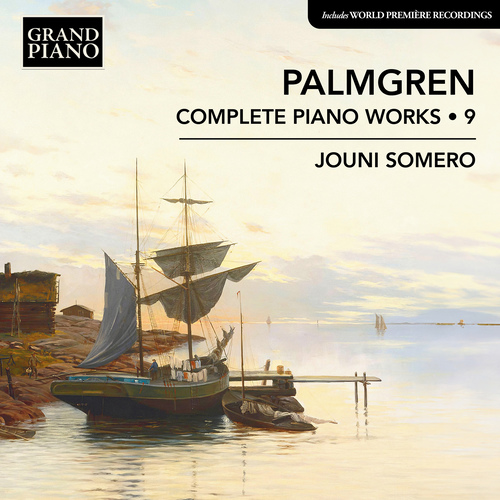
About this Release
PALMGREN, SELIM (1878–1951)
Complete Piano Works • 9
- Jouni Somero, piano
Selim Palmgren was one of the most celebrated pianist-composers in the years before the end of the First World War. His vast catalogue of piano music, much of it unknown, is showcased in this acclaimed series performed by Jouni Somero, the Finnish composer’s greatest modern exponent. This volume features the virtuosic and demanding Fantasie, Op. 6, one of Palmgren’s most compelling works, as well as examples of music irradiated by Impressionism and Nordic folklore. Miniatures including études, waltzes and pieces that exude Chopinesque charm are also featured.
Tracklist
|
3 Humoresques, Op. 26 (1908) (00:09:00 )
|
|
1
No. 1. Allegro con burla (00:02:54)
|
|
2
No. 2. Allegro con burla (00:01:31)
|
|
3
No. 3. In Form eines Walzers: Allegro brioso - Movimento di Valse (00:04:39)
|
|
4
Fantasie, Op. 6 (1900) (00:08:35)
|
|
5
Romance, Op. 73, No. 1 (1920) (00:03:52)
|
|
6
Cortège gracieux, Op. 73, No. 2 (1920) (00:01:14)
|
|
7
Hämäränhaaveilu (A Twilight Fantasy), Op. 73, No. 3 (1920) (00:02:14)
|
|
8
Murgröna (Ivy), Op. 73, No. 4 (Op. 64b, No. 1) (1922) (00:02:11)
|
|
Graciösa rytmer (Graceful rhythms), SP72 (1920) (00:04:00 )
|
|
9
No. 1. Ringlek (Ring Play) (00:02:29)
|
|
10
No. 2. Piccolo menuetto (Little Minuet) (00:01:41)
|
|
11
Humoreski (Humoresque), SP90 (1907) (00:01:16)
|
|
12
Humoreske (Humoresque), SP89 (1890) (00:01:37)
|
|
13
Humoreske (Humoresque), SP88 (1896) (00:00:51)
|
|
14
Harjoitelmia ja tunnelmia (Exercises and Moods), Op. 108: No. 1. Juhlallinen tulo (Festive Procession), SP117 (1948) (00:01:19)
|
|
15
Harjoitelmia ja tunnelmia (Exercises and Moods), Op. 108: No. 2. Ensimmäinen perhonen (The First Butterfly), SP51 (1948) (00:01:11)
|
|
16
Harjoitelmia ja tunnelmia (Exercises and Moods), Op. 108: No. 3. Talvimaisema (Winter Landscape), SP299 (1948) (00:01:54)
|
|
17
Versöhnung (Reconciliation), SP332 (1894) (00:01:16)
|
|
18
Scherzo, SP246 (1893) (00:03:15)
|
|
19
Intermezzo valsant, Op. 65 (1918) (00:02:53)
|
|
20
Spinnrocken (The Spinning Wheel), SP276 (1916) (00:02:34)
|
|
Klanger och rytmer (Sounds and Rhythms), Op. 64 (1918) (00:16:00 )
|
|
21
No. 1. Gondoliera veneziana (In a Gondola) (00:04:29)
|
|
22
No. 2. Midsommarlek (Finnish Dance [No. 1]) (00:01:51)
|
|
23
No. 3. Gavotte (00:03:34)
|
|
24
No. 5. Vestfinsk polonäs (Finnish Dance [No. 2]) (00:02:26)
|
|
Nordischer Sommer (The Summer of the North), Op. 39 (1914) (00:15:00 )
|
|
25
No. 1. Abendstück (Evening Piece) (00:03:19)
|
|
26
No. 2. Am Bach (On the Brook) (00:02:14)
|
|
27
No. 3. Tanzstück (Dancing Piece) (00:01:12)
|
|
28
No. 4. Kleine Ballade (Little Ballade) (00:02:59)
|
|
29
No. 5. Hochzeitsmarsch (Wedding March) (00:04:33)
|
The Artist(s)
 JOUNI SOMERO is one of the most active performers among present Finnish musicians. He has given over 3,500 concerts in many countries worldwide. He studied piano in Switzerland and at the Music Academy in Cologne under Professor Herbert Drechsel, and, under the legendary Hungarian pianist Georges Cziffra, he deepened his knowledge of the interpretation of Liszt’s music. Michael Ponti, the American virtuoso, has also acted as Somero’s musical advisor. Jouni Somero’s recording career began in 1989 (with Liszt’s 12 Transcendental Études), after which he has made over 100 recordings for different labels, including Naxos. His wide repertoire includes all the solo piano works of Rachmaninov, Tchaikovsky and Bortkiewicz, as well as seldomly heard music by, among others, Alkan, Godowsky, Rubinstein, Reinhold, Godard, Cui and Gottschalk. He has also made several piano arrangements of orchestral, operatic and pop music, and his YouTube channel has gained millions of views.
 The Composer(s)
 During the first decades of the past century Selim Palmgren, a pupil of Ferruccio Busoni and Conrad Ansorge, was undoubtedly one of the most performed Nordic composers of piano music. His piano works, including hundreds of pieces and five piano concertos, were being widely performed, and even recorded, by some of the greatest pianists of the era, including Ignaz Friedman, Myra Hess, Wilhelm Backhaus, Benno Moiseiwitch and conducted by star conductors the likes of Arthur Nikisch, Leopold Stokowski and Václav Talich, to name a few. Palmgren’s music was being widely published and distributed by well-known music publishers both in the US and in Europe.
 Also Available
 Grand Piano has gained a reputation for producing high quality recordings of rare keyboard gems. Dedicated to the exploration of undiscovered piano repertoire, the label specialises in complete cycles of piano works by many lesser-known composers, whose output might otherwise have remained unknown and unrecorded.






- info@grandpianorecords.com
